

Last Updated: September 4, 2026
Magnesium Glycinate is a type of magnesium that is bound to glycine, an amino acid with relaxation-inducing qualities.
This isn’t just a random pairing, either—glycine actually assists your body in absorbing magnesium through the process of digestion, which makes this type one of the most bioavailable forms and easier on your stomach than some others. And while several other forms of magnesium supplements can irritate the stomach or have a laxative effect, magnesium glycinate is gentle on the digestive tract, making it a go-to recommendation for people who need ongoing magnesium support.
This Article Belongs to Supplements
Table of Contents
How Magnesium Glycinate Functions in the Body
Magnesium functions by delivering magnesium to the body in a form that is easily absorbed and carefully prepared for digestion. When consumed, it breaks down into magnesium and glycine, both of which are essential for cellular processes.
While glycine, a neurotransmitter, encourages relaxation, magnesium controls blood sugar dynamics, energy flow, visceral muscle responses, and nerve signals. Therefore, they will restore equilibrium, reduce nervous system overstimulation, and aid restful sleep, which explains why magnesium glycinate treatment is effective for patients under stress, with tense muscles, or with low magnesium levels.
Magnesium Glycinate vs Other Forms of Magnesium
| S.no | Type of Magnesium | Absorption Level | Main Benefits | Digestive Tolerance | Best For |
| 1 | Magnesium Glycinate | Very high | Supports sleep | Very gentle | Sensitive stomachs |
| Reduces anxiety | Stress | ||||
| Muscle relaxation | Insomnia | ||||
| improves deficiency | Long-term | ||||
| 2 | Magnesium Citrate | High | Relieve constipation | Moderate | constipation |
| Muscle and nerve function | short-term | ||||
| 3 | Magnesium Oxide | Low | High elemental magnesium | Poor | People needing a laxative effect |
| 4 | Magnesium Malate | Good | Energy production | Generally well | Chronic fatigue |
| Reduces muscle fatigue | Muscle pain | ||||
| Fibromyalgia | |||||
| 5 | Magnesium Threonate | Moderate | Brain health | Gentle | Memory |
| Cognitive function | Focus | ||||
| 6 | Magnesium Chloride | Moderate | Well digestion | Irritate stomach | Topical use |
| Electrolyte balance | Digestive support | ||||
| 7 | Magnesium Sulfate | Low | Muscle relaxation | Not suitable for oral use | Bath soak |
| Detox support | Muscle soreness | ||||
| 8 | Magnesium Taurate | Good | Heart health | Gentle | Cardiovascular support |
| Blood pressure |
Who Commonly Prescribes / Recommend It
| S.no | Specialist Type | Role / Why They Recommend | Examples |
| 1 | General Physician (GP) | For deficiency symptoms | Fatigue, cramps |
| 2 | Endocrinologist | For metabolic and hormonal impact | Insulin resistance |
| 3 | Cardiologist | For heart rhythm support | BP regulation |
| 4 | Neurologist | For muscle & restless legs. | Migraines |
| 5 | Dietician / Nutritionist | For dietary correction | Supplement Intake |
| 6 | Gastroenterologist | For digestive tolerance | Gentler on the stomach |
Locations Country-wise Availability
| Country | Availability in Stores | Local Market Characteristics |
| USA | Health stores & Online | large e-commerce |
| UK | Pharmacies & online | Strong interest |
| India | Online > retail | market growing rapidly |
| Australia | Health shops & online | Preference for high-quality |
| Canada | Pharmacies & natural health stores | Rising demand due to preventive health trends |
| China | Consumer market & Online | One of the largest global manufacturing |
| South Africa | Emerging supply in health stores & online | Growth tied to wellness trends |
| UAE | Limited local availability | High health & wellness interest |
Approximate Pricing and Market Demand
| Country | Local Currency Price Range | Market Notes |
| USA | $12 – $35 USD | Widely available |
| UK | £10 – £30 GBP | Prices vary by brand quality |
| India | ₹500 – ₹2,200 INR | Online platforms |
| Australia | AUD 18 – 45 | Higher regulatory standards |
| Canada | CAD 15 – 40 | Natural Health costs. |
| China | ¥60 – ¥220 CNY | Large domestic production |
| South Africa | ZAR 180 – 520 | Mostly health stores & online |
| UAE | AED 55 – 150 | Imported; higher logistics costs. |
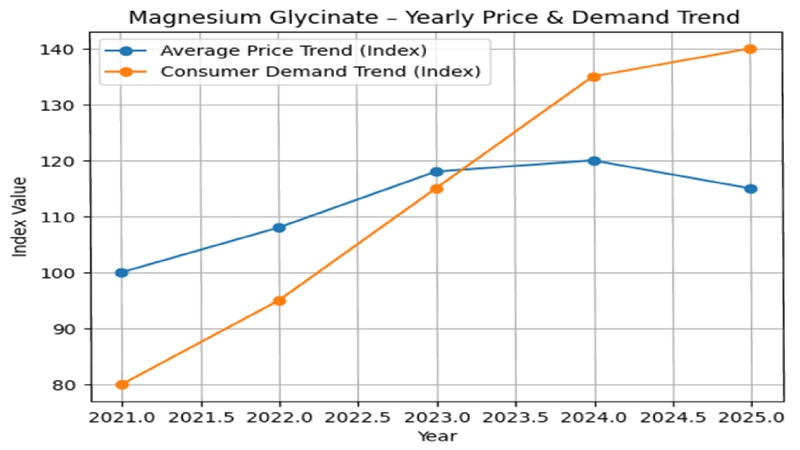
Yearly Price Trend & Demand Graph
Key Health Benefits of Magnesium Glycinate
| S.no | Health Benefit | How Magnesium Glycinate Helps | Who Benefits Most |
| 1 | Improves Sleep Quality | Calms the nervous system | People with insomnia |
| Supports melatonin regulation | Poor sleep cycles | ||
| Restful sleep | |||
| 2 | Reduces Stress & Anxiety | Promotes relaxation | Dealing with anxiety |
| Lowers stress | Mental fatigue | ||
| Improves hormone activity | |||
| 3 | Supports Muscle Relaxation | Muscles relax | Athletes |
| Reducing cramps | People with muscle pain | ||
| 4 | Gentle on Digestion | Highly absorbable | sensitive stomachs |
| Cures stomach upset | |||
| 5 | Boosts Energy Production | Aids in ATP (energy) production | People with low energy or fatigue |
| 6 | Supports Heart Health | Regulates heartbeat | Cardiovascular health |
| Healthy blood pressure | |||
| 7 | Improves Bone Health | Enhances calcium | Older adults |
| bone strength | Post-menopausal women | ||
| 8 | Relieves Headaches & Migraines | Reduce nerve overstimulation | Migraine sufferers |
Best Time to Take Magnesium Glycinate (Morning vs Night)
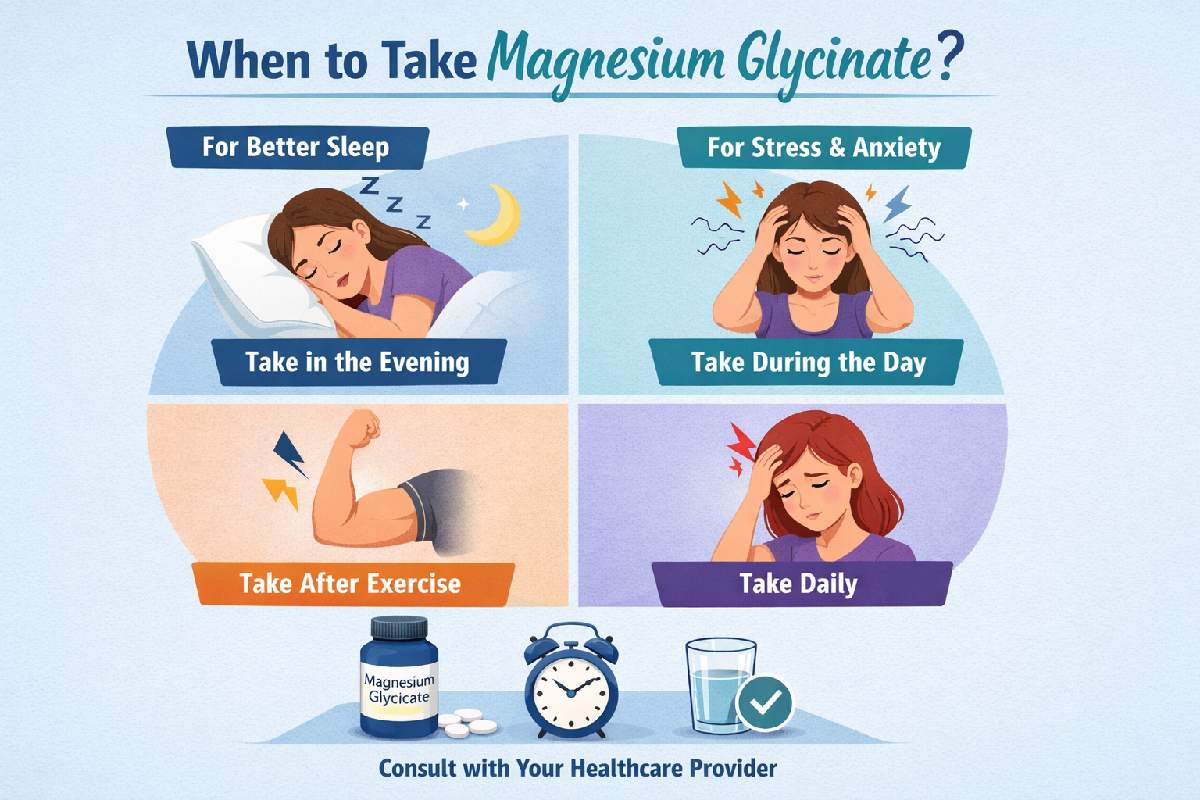
The best time for magnesium glycinate supplementation depends on your needs, but generally, taking it before bed is most advisable. This supplement also has a calming effect on the body, relieving both nerves and muscles, and is therefore beneficial for promoting good sleep. The supplement should be taken 30-60 minutes before bedtime.
Nevertheless, some people prefer taking magnesium glycinate in the morning, which is particularly advisable if one is taking this magnesium supplement to support muscle function and energy metabolism, and to relieve stress throughout the day. Since this is a gentle stomach supplement, one can take it before and after meals, or whenever one feels like it.
Signs and Symptoms of Magnesium Deficiency
| Area Affected | Symptoms |
| Energy Balance | Weakness & Fatigue |
| Hormonal (Women) | Mood swings & PMS cramps |
| Muscles | Twitching, Cramps & spasms |
| Sleep | Insomnia & restless sleep |
| Head & Nerves | Headaches & migraines |
| Heart Health | heartbeat Irregular |
| Mental Health | Anxiety & irritability |
Side Effects and Safety Considerations
| Aspect | Details |
| Common Effects | Bloating (rare) & Mild nausea |
| Digestive tolerance | Causes diarrhea (rare) & is very gentle. |
| Risk of Overdose | High doses may cause drowsiness/low BP. |
| Medication Impact | May interact with diuretics & antibiotics |
| Who Should Be Careful | kidney disease people |
| Safety Overview | Safe for daily use when taken as directed |
Bottom line
Magnesium glycinate isn’t about putting you out or clouding your brain. It’s about letting your body relax, in a subtle, consistent way.
But if you take it at the right time and in the correct dose, it will work with your body. It won’t work against it. Honestly? This is why it is such a popular product.
Disclaimer
The data presented in the above content is intended to be informative and educational in nature and should not be considered as the provision of medical advice, diagnosis, or treatment. Magnesium Glycinate is an NDI, and its effects may vary from person to person.
Always consult a licensed healthcare professional or a pharmacist before beginning, stopping, or altering supplements or medication usage, especially if pregnant or breastfeeding, suffering a medical condition, or taking prescribed medication.
Magnesium is an essential mineral involved in hundreds of biochemical processes, including muscle and nerve function, protein synthesis, blood glucose regulation, and blood pressure. For evidence-based information about magnesium, recommended intake, supplement safety, and potential medication interactions, see the NIH Office of Dietary Supplements Magnesium Fact Sheet