

Last Updated: August 31, 2026
Artificial nails are one of the cheapest ways to achieve nails of a greater length, strength, and generally more elaborate design than your own nails can grow on their own but “artificial nails” is not a single product.
Instead it‘s a master category that encompasses a variety of very different systems: acrylic, gel, dip powder, press-ons, polygel, and a few newer hybrids, each with its own price point, durability, and effect on the health of the natural nail beneath.
If you have had a conversation in the salon where a nail technician glibly asks “acrylic or gel?” without clarification, this is your go-to resource. Below you‘ll find what each formulation is actually made of, how long each one realistically can be expected to last, the cost in India and the US, which type is best for your nail aspirations and health, and the right way to apply, remove, and maintain your fake nails.
This artical belongs to Makeup & Nails.
Table of Contents
What Are Artificial Nails?
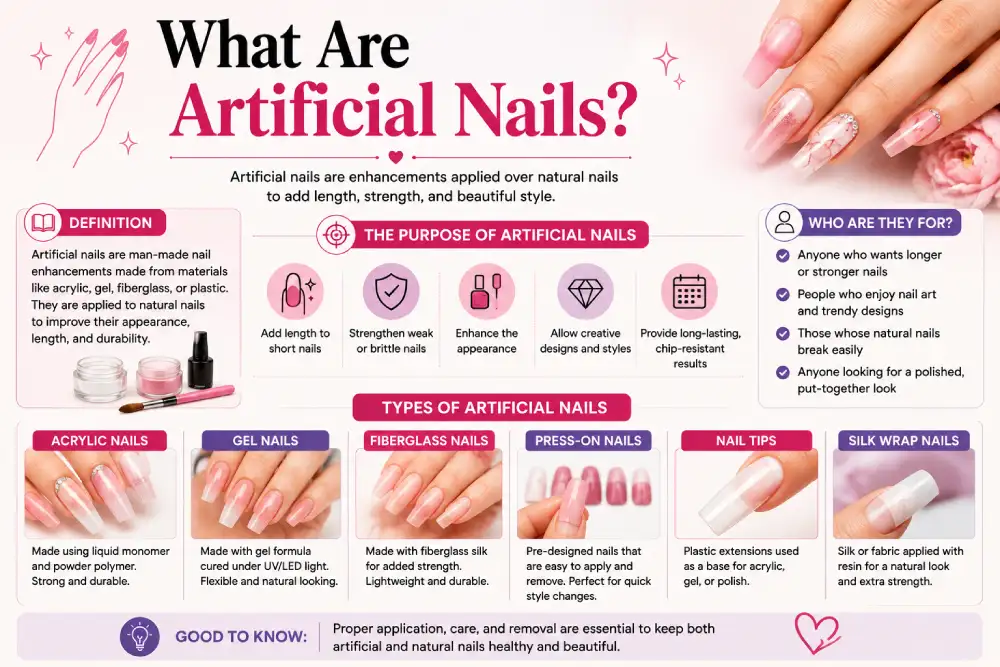
Artificial nails also known as false nails, fake nails, or nail enhancements are a form of artificial extension or overlay that is placed on top of a natural nail. They are used to add length to the nail, create a different shape or strength to the natural nail, or to provide a surface for decoration. They do not replace your natural nail but are merely placed onto the surface of it, either as a hard overlay coating or as a glued on general shape.
There are two structural approaches used across almost every type of artificial nail:
- Tips lightweight, nail shaped plastic bits glued onto natural nail free edge to extend length, then covered or dipped with acrylic, gel or polish.
- Forms Flexible nail forms, with sticky back, that are adhered to the top and bottom of the entire nail and used as a temporary mold to sculpt gel or acrylic directly on top of.
Either way, there‘s someone you can visit and get your fake nails filed into these shapes, and taken all the way to the top coat with gel, regular, or dip powder. Or have a magnificent set of artificial nails decorated or painted for whatever occasion.
Types of Artificial Nails at a Glance
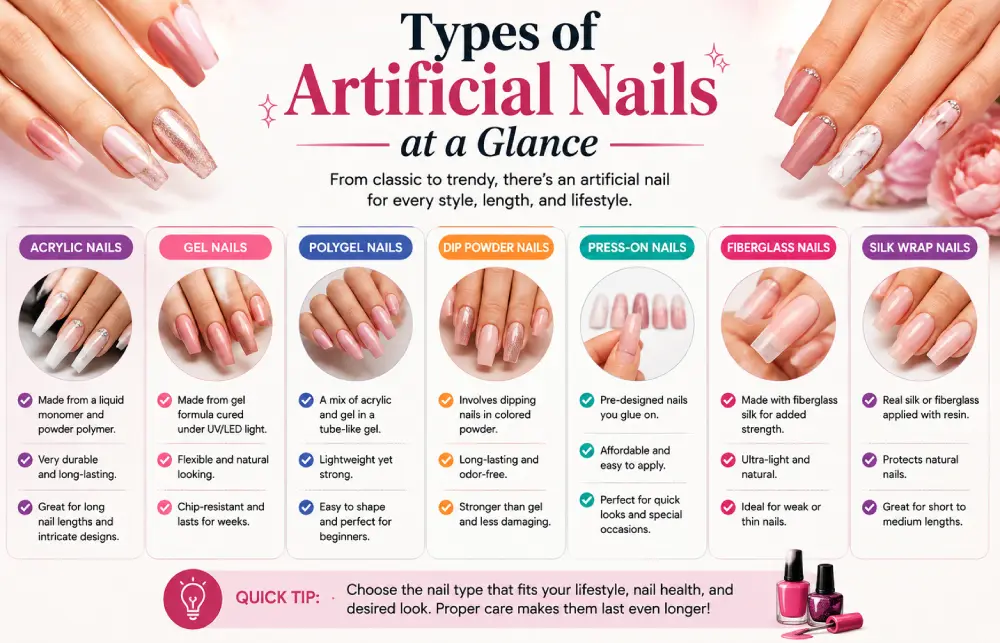
Before going deep on each type, here‘s how the main options stack up against each other:
| Type | What It‘s Made Of | Typical Wear Time | UV/LED Lamp Needed | Best For |
| Acrylic | Liquid monomer + powder polymer | 3–6 weeks (with fillings) | No | Maximum length and strength. The effective length of a cantilever is the diagonal length from the fixed support to the point at which the applied load causes failure. The maximum length of a cantilever beam is ten times the width. If the maximum length is exceeded the cantilever will buckle. |
| Hard Gel / Gel-X | Soft or hard gel resin. | 2–3 weeks (gel)/3+ weeks (Gel-X) | Yes | A glossier, more flexible extension. |
| Dip Powder | Adhesive base + colored powder. | 3–4 weeks | No | Long-lasting color without a lamp |
| Press-On Nails | Pre-made plastic/gel nail + glue/tabs | 1-2 weeks (tabs)/ longer (glue) | No | Fast, low-commitment, DIY |
| Nail Wraps | Fiberglass, linen and silk + resin/glue! | 1–2 weeks | No | Nails that are weak or damaged |
| Polygel | Acrilic/gel hybrid gel. | 3+ weeks | Yes | Strength in a lightweight package with fl exibility |
| Builder Gel (BIAB) | Semi-hard gel overlay, flexible. (Note also that 80, 81, 8 3, 8 4, 8 5 appear to be semi-hard gel overlay). | 3–4 weeks | Yes | Strengthening natural nails, not lengthening them |
Acrylic Nails
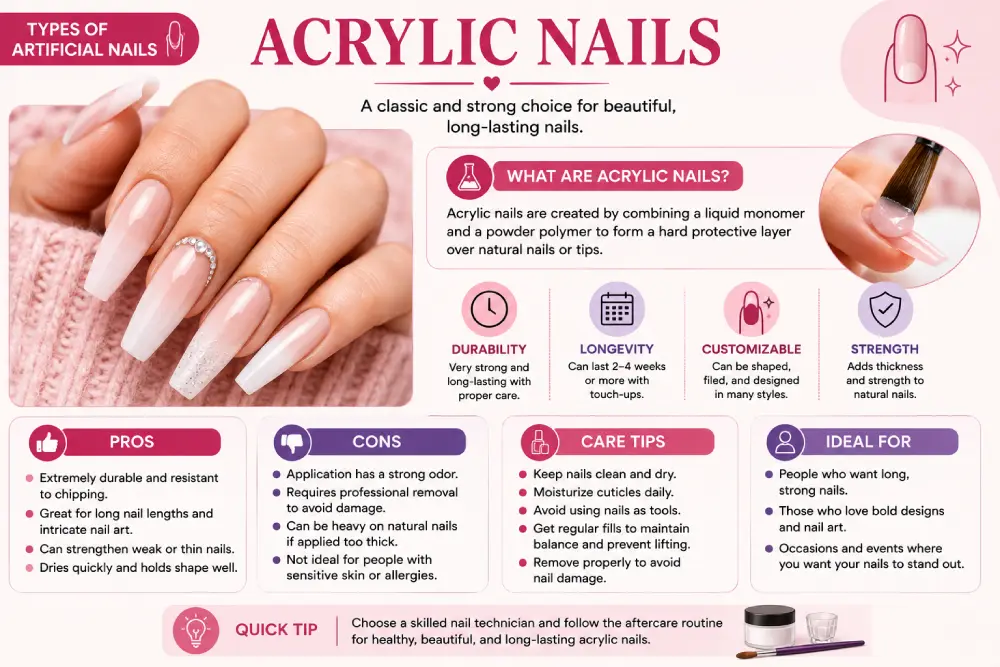
Acrylic nails are the most common, and therefore the most widely available artificial nail. They are made by combining a liquid monomer, usually ethyl methacrylate, with a powder polymer. The two form into a soft, workable bead. This bead is then sculpted onto a tip or form, and hardens chemically (no lamp needed) in a matter of minutes.
Acrylics are known to be the strongest and most rigid, and are therefore still used when someone wants amazing length or has fragile, soft natural nails that are unable to bear full cover extensions. They are usually worn for three to six weeks, with fill-ins done every two to three weeks to fill in the new growth at the cuticle. They can be worn in one opaque color using Gel Polish, Nail Polish or dip powder, and they are ideal for detailed artwork because of their very hard surface.
The disadvantages are weight and maintenance. Acrylics are heavier than gel, the application involves more highly odorous chemicals, and peel-offs or pried-off instead of soaking is one of the most common causes of thin, damaged natural nails. If you love the idea of bold, long, sculpted nails including seasonal designs, our roundup of Valentine’s Day acrylic nail designs is a good place to see what’s possible with this type before you get an appointment.
Gel Nails and Gel-X
Gel nails utilise a resin-based Formula which is cured under UV or LED light, rather than air drying. As a nail varnish, gel is a high shine, chip resistant finish that has a life of about two to three weeks. As an extension system gel is applied over tips or forms in the same way as acrylic, but is lighter and more flexible, and lacks the “monomer” odour.
Gel normally is softer than acrylic, so would not be the best choice if you want excessive length and your hands are ‘touched’ often. It will chip or lift more quickly under stress. In general it is more costly and, although most new soak off gels will release with acetone, some gel formulas are best buffed off in the salon and continually buffing will thin the natural nail plate.
One of the most widely used next-step evolutions in this category is Gel-X. This pre-formed, soft gel tip completely encapsulates the entire length of the natural nail bed to the free edge. The gel tip is adhered to the nail with a de-hydrating primer and an acid-free gel base. The gel is then bonded and hardened under UV or LED lights, producing a salon-worthy length that is not built by hand. Gel-X is one of the fastest-growing options for this kind of enhancement because it combines the speed of a flat press-on with the durability of a fully cured gel system and can be soaked off in 20 minutes rather than filed away.
Dip Powder Nails
Dip powder is a great in-between for gel and acrylic. you apply a clear or tinted base liquid on the nails, then either sprinkle your finger into a very pigmented powder, or brush the powder onto the finger, then seal with the activator and topcoat. No ring with a lamp is neede and so it‘s a nice option for anyone who want‘s gel durability without the lamp.
Dip powder nails can last approximately 1 month often 2-3 weeks longer than gel or regular acrylic and the finish is more hardwearing than gel polish but slightly more flexible than a full acrylic extension. It can be applied either as simple color on the natural nail or built-up to provide some light length. One point to note on this is that due to the repeated dipping into the same jar of powder at many salons if this is something that‘s a concern to you ask whether they use single-use pots or a ‘dip and pour’ method rather than a jar for hygiene reasons.
Nail Wraps
Nails wraps are cut to size from fiberglass, linen, silk or other durable material to match the size and shape of the nail to be covered (or a pre-bonded tip), and then sealed using resin or glue. Unlike acrylic or gel, wraps are not a significant lengthener, but are instead a temporary strengthener for a weak or damaged natural nail, or a cover for a crack or break. As they do not add additional bulk and significantly fortify the underlying nail they tend to be one of the least damaging options, but is also on the shorter side of longevity: expect about five to fourteen days.
Press-On Nails and Nail Tips
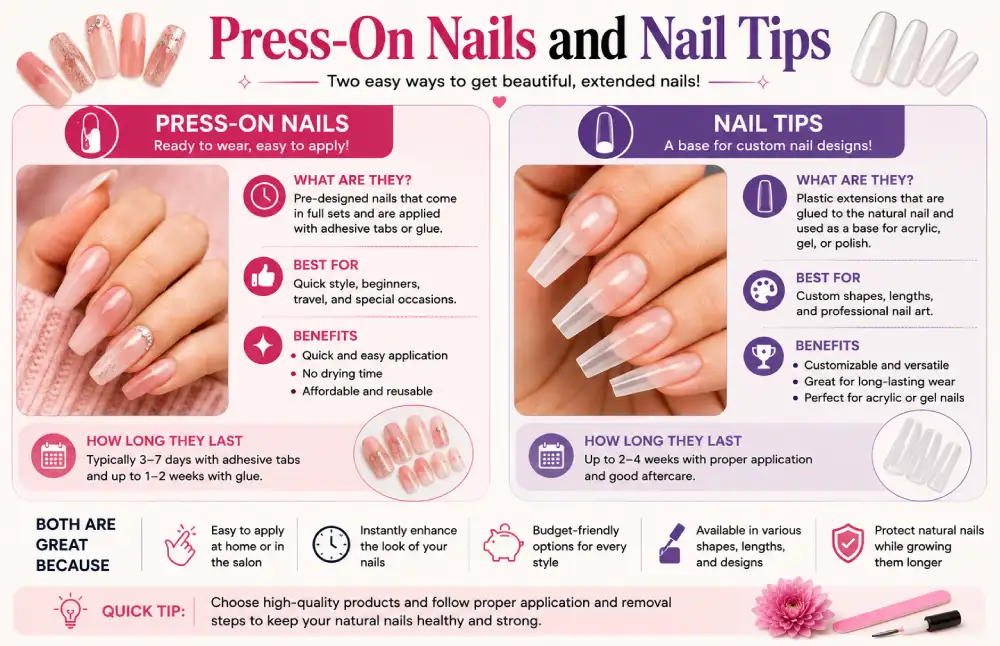
Press-on nails are pre-made artificial nails that are applied over your own natural nails using glue or adhesive stickers. This means that there is no need to go to a salon to have a full set applied, no lamp, and no wait while the product dries, all you need is patience as the glue sets. There has been a massive leap in quality over the past few years; many modern handmade press-on sets preform similarly to salon options and because of the lower prices they are normally a much better deal. When used with glue, they will last about 2 weeks and with tabs, you can expect to see about 2 weeks to 2 months of wear and tear from them.
Compare this to nail tips, which are the lightweight (usually ABS) plastic forms glued on the free edge of the natural nail to lengthen it, and finished in acrylic, gel, or polish rather than worn naturally. Nail tips will wear down to nothing is a matter of days, about 7-10 days for uncoated tips, before requiring further enhancement or replacement.
The simplest way to learn how to do nails if you are new is to start with either the round or oval. (Great way for you to experiment with shape and length options and colors before you commit to a multi-week fill-in!) Both are the simplest entry point if you‘re new to artificial nails and want to test shapes, lengths, and colors without committing to a multi-week fill-in schedule.
Polygel and Builder Gel (BIAB)
Two more newer categories are interesting to know about if you‘ve only dabbled in the classics. Polygel is a mix between two of the previous categories quite like the putty that is baked in the oven to make a sculpture. It has the strength of acrylic and the flexibility of gel, and is applied like putty in a paste, worked onto the nail or form by hand, cured under lamp and produces a lightweight, very strong extension without the monomer smell of acrylic. This is mainly a professional-salon offering.
Builder gel sometimes called BIAB (“Builder in a Bottle”) is a semi-hard gel applied like polish, directly onto a natural nail (NOT onto a tip or a sculptured extension) in order to provide strength and minimal length while lengthening. Prior to the rise of dip powder, it was the most often-sought after “strengthening overlay” for clients wishing to grow long, strong natural nails while in color, and dermatology-informed rankings tend to place it near the gentlest extremes of the traditional acrylic set, as there is no monomer smell and there is less filing.
How Long Do Artificial Nails Actually Last?
One of the most frequently asked questions we hear before booking is this so here‘s a realistic range (if you wear it as directed and wash it in the laundry, not according to the marketing) among others:
- Acrylic: 3–6 weeks, when they need to be filled every 2–3 weeks
- Gamete Formation: Quality of Gametes: Shells: Before gonads develop An ungle part of egg fertilization is. Thus quality of the bones is vital. The coating of the eggs. 2–3 weeks: Length of time.
- Gel-X: 3+ weeks. Gel-X isn’t a gel; it is a system that sticks on the natural nail in a similar way to a false nail. It is is one part that dries and sets hard on the natural nail in no time at all.
- Dip powder: 3–4 weeks
- Polygel: 3+ weeks
- Builder gel (BIAB): 3–4 weeks.
- Press-ons (tabs): 1–2 weeks
- Press-on (UV glue): 2–3 weeks
- Nail wraps: 5–14 days
- Unaired tips: 7–10 days(7–9 days For soft tip)
The actual wear time will vary directly with the amount your hands are used on a daily basis. Tasks such as dishwashing, gardening, typing or even the “use your nails as tools” mentality all contribute to a shortened wear time of any artificial nail system.
Cost of Artificial Nails: US and India
Pricing varies a lot by city, salon tier, and design complexity, but as a general planning guide:
| Type | Typical US Price (full set) | Typical India Price (full set) |
| Acrylic | $35–$70 | ₹800–₹2,500 |
| Gel | $40–$80 | ₹1,000–₹3,000 |
| Gel-X | $50–$90 | ₹1,500–₹3,500 |
| Dip Powder | $35–$65 | ₹1,000–₹2,500 |
| Polygel | $45–$85 | ₹1,500–₹3,500 |
| Press-ons (at-home) | $10–$40 | ₹300–₹1,200 |
Fills, removals, specialized nail art (chrome, hand painted art, 3D detailing) may be tagged on to the cost of the glam and is usually charged separately although it can amount to a lot in metro salons.
How to Choose the Right Type for You
There‘s no single “best” artificial nail the right choice depends on what you‘re optimizing for:
- If you want a product that is strongest and longest, acrylic or polygon is the best choice.
- Want a more natural looking, more shiny finish with less bulk? Gel or Gel-X.
- Looking for a long lasting color but never have a lamp? Dipping powder.
- Want to test it yourself with no obligation? Press-on or nail tips.
- Looking to condition and improve the appearance of weak or damaged natural nails during the growing stage? If so, use nail wraps or a builder gel, (BIAB).
- Have sensitive skin or an allergy history? Ask your technician about builder gel or well-cured gel polish first, and always try to keep any liquid product off your skin, not just the nail — and if breakouts around the cuticle or fingertip skin are already a concern for you, it’s worth reading up on choosing the right primer for acne-prone skin as part of a broader skin-sensitivity routine.
- On a tight budget, or pressed for time? Press-offs provide the most similar to a salon set at the lowest price and without the appointment time.
How Artificial Nails Are Applied
While the exact steps vary by system, most salon applications follow a similar sequence:
- Prep Natural nails are cleansed, Cuticles are lightly pushed back/trimmed and Nail surface lightly buffed so product adheres.
- Extension (if adding length) An extension is either glued on or a form is wrapped around the nail to be used as a mould.
- Product application Acrylic is sculpted on, gel is brushed and cured under a lamp or the nail is dipped into powder then sealed.
- Shaping – The nail is filed into the desired shape (square, almond, coffin, stiletto etc) and the surface is buffed.
- Finish color, gel polish or nail art is applied and, for gel based system, cured under UV/LED light before fi nish with a topcoat.
Removing Artificial Nails the Right Way
Remove is actually where most of the trauma to the natural nail occurs – not the wearing of the artificial nail. Peeling, picking and prying off acrylic, gel or press-on tips erodes layers from the natural nail plate.
The safest way to remove almost all hard-gel or acrylic systems is soaking: file nail to break the surface seal, then wrap in acetone-saturated cotton pad and foil (or soak directly in a bowl) for 10–20 minutes until product is soft enough that it can be slid or buffed off easily without prying. Dip powder will generally require a little longer soak. Tab-press-on tips can be removed fairly easily with warm, soapy water: glued-on presses need to be acetone soaked as well.
If you‘re doing your own home removal, do so patiently, slather on some cuticle oil to rehydrate your cuticles immediately afterward, and let your natural nails rest for a short period before your next set if yours appear thin and ridged, or if they feel sensitive.
Nail Health and Safety Considerations
Artificial nails are meanwhile something that, as with anything, are anything but harmful if put on and taken off properly, and there are a few things I believe you should know rather than find out:.
Allergic reactions are the most common issue. According to the FDA’s overview of nail products and ingredients, artificial nails are made mainly from acrylic polymers formed by reacting acrylic monomers — ethyl methacrylate (EMA), for example — with polymers such as polymethylmethacrylate, and small traces of uncured monomer can remain even after the nail has hardened. These traces, rather than the hardened nail itself, are usually the cause of irritation and pain from skin contact. A related but stronger substance, methyl methacrylate (MMA), was targeted for removal from the market by the FDA back in the 1970s because it could cause allergic reactions and, at worst, permanent damage to a finger or nail — but it can still turn up occasionally in cheap products and is recognizable by a distinctive, pungent chemical smell quite different from “normal” acrylic liquid.
Sensitization can accumulate with further exposure. Researchers investigating the role of sensitisers in dermatology have attributed an increased trend for (meth)acrylate contact allergy to nail enhancements, often in response to uncured product making skin contact, which is more likely with kit-bought gels than an experienced technician working cautiously on and around the cuticle.
A few practical safety habits go a long way:
- Select a salon that provides ventilation for the workspace and regulates the air and fresh product is stored correctly.
- Be sure that no liquid monomer or uncured gel comes in contact with your skin not just the nail.
- Test strips are completely cured under the lamp for the time specified by the manufacturer; under curing can cause an allergy.
- If you develop continual redness, swollenness, irritation or the nail lifting with a pain (not simply a cosmetic lifting), discontinuing wearing that product and consult a dermatologist.
This safety information is of a general nature, it is not an offer of medical advice. If you have a diagnosed skin problem, a known allergy or ongoing pain in your toenails then speak to a dermatologist before embarking upon a new nail enhancement regime.
Caring for Your Natural Nails Between Sets
However, the state of the nail you‘re wearing in the end results for the health of the nail underneath mostly from what occurs before application and after removal. As a general rule, maintain moisture on the nail bed and cuticles by regularly applying cuticle oil, don‘t put on a fresh set immediately after removal if the nail appears thin or ridged, and give your hands a breather of a few weeks between sets when possible. Diet can also play a part in providing nutrients for stronger nails in the long term biotin and vitamins C and E are often cited when talking about nail and hair health and some readers consider taking a hair, skin, and nails supplement as part of that routine. As always, consult with a medical professional before taking any kind of supplement, especially if pregnant, planning to become pregnant, or undergoing other treatment.
Common Mistakes to Avoid
- Peeling or picking up product rather than soaking off – the number one cause of thin, damaged nails.
- Panicky filling. Don‘t extend fill volume for too long i.e. leave a big gap of new growth as this puts uneven pressure on the extension and it is more prone to lift.
- ( nails already appear week and ridged) Going straight into a new set without a break.
- Repeated skin contact with uncured gel or liquid monomer increases the chance of developing an allergic reaction.
- Pointless when its the cheapest – not even checking what product is being used certain Ultra Low Cost acrylics can and some still use MMA based liquid, which has an added risk over standard EMA acrylic.
Myth vs. Fact
| Myth | Fact |
| Artificial nails can ruin your natural nails. | They don‘t damage the nail directly, it‘s the wrong removal and failure to take a break when using them. |
| “Gel is always softer than acrylic.” | Gel is softer in general, but by buffing continuously is for removal of some gel formulas as this is, it‘s also thinning the nail plate. |
| Every artificial nail will require a UV lamp. | As a general rule, acrylic, dip powder and most press-ons do not need any light to be cured. |
| “One for each type of salon you need.” | Press-ons and a few polygel or dip powder kits can be used at home with confidence. |
| The acrylic for cheaper is identical to the market acrylic. | Sometimes the very low-cost sets replace the conventional EMA with MMA based liquid which have a higher risk profile. |
Frequently Asked Questions
What’s the difference between acrylic and gel nails?
Acrylic is a mixture of liquid and powder which air-dries, and gives the most strength and length; gel is a resin which is cured under UV/LED light, it is lighter, glossier but usually less hard.
Are artificial nails bad for your natural nails?
Not really it‘s more about removing on a peel rather than soak (peel not soak remember), and taking breaks between sets, when you‘re actually wearing them.
How often do artificial nails need to be redone?
The majority of types require a fill every 2–3 weeks to match the new nail growth and a complete new set approximately 4–6 weeks depending on material used.
Can I apply artificial nails myself at home?
Yes, also press-ons, nail tips, and some dip powder or polygel kits that are meant for doing at home. I think that acrylic and gel extensions are more difficult to do successfully at home and tend to look a lot better when done by a trained tech.
Do artificial nails hurt to remove?
Shouldn‘t if taken off correctly with an acetone soak instead of peeled or pried off- forceps on the nail-plate itself is what hurts and damages the-platen.
Is dip powder safer than gel or acrylic?
It isn‘t inherently safer or riskier — the big practical difference being, dip powder doesn‘t require the UV/LED lamp, whereas hygiene (joint use of powder jars) is the bigger issue to bring up with your salon.
How do I know if I’m allergic to artificial nail products?
Check for redness, swelling, itching or pain on or around the nail or skin after use. If these symptoms occur repeatedly while wearing this product, consult a dermatologist for patch testing.
The Bottom Line
There is a broad spectrum of artificial nails options and what would be the “best” for a person really depends on how much strength, length and wear-time they want vs how much maintenance and lamp/salon time they are willing to invest.
Acrylics & polygel provides the most length and strength, gel & Gel-X provide a more shiny, lighter weight finish, the dip powder systems provide strong colour without the lamp, and the press-ons or builder gel are the gentlest options for entry if you are unfamiliar with or trying to protect your natural nails that are in a healing phase.
Whatever product you choose, the single largest factor in how your natural nails come out after removal is not the product but the process, which includes proper application, complete curing and a careful soak-off removal rather than peeling.